i
Balkans · ex-Ottoman
Balkan Brass
With the Ottomans, coffee came to Europe — and with it the cezve, Turkish coffee. The brass carries the night.
Balkan Brass — Ecstatic brass music of the Balkans, often played by Roma bands, grown out of Ottoman military music and local folklore.
Definition after Wikipedia, edited
i
Eastern Europe · diaspora
Klezmer
The music of the Central European coffee houses, where people sat for hours over a single cup, talking and playing.
Klezmer — Instrumental music tradition of the Ashkenazi Jews of Eastern Europe, shaped by clarinet and violin — between exuberance and melancholy.
Definition after Wikipedia, edited
i
Portugal · Lisbon
Fado · 19th century
Longing in a minor key — and the bica, the small dark espresso taken standing up. Portugal carried coffee across the seas.
Fado — Portuguese song genre from Lisbon, since the 19th century, melancholic and shaped by “saudade” (longing), accompanied by the Portuguese guitar.
Definition after Wikipedia, edited
i
Spain · Andalusia
Flamenco
Coffee travelled to the New World by way of Spain. Along with it, a café con leche and the clapping of hands.
Flamenco — Andalusian art form of song (cante), guitar (toque) and dance (baile) with Roma roots — passionate and rhythmically complex.
Definition after Wikipedia, edited
i
France · Paris
Gypsy Jazz · 1930s
Django in the cafés of Paris — the place where the coffee house became a stage.
Gypsy Jazz — Also “jazz manouche”: the jazz style shaped by Django Reinhardt in Paris in the 1930s, with acoustic guitars — virtuosic and swinging.
Definition after Wikipedia, edited
i
Brazil · Rio
Bossa Nova · 1950s
The country that supplies the world with coffee. Quiet guitar, soft voice — the sound of the cafezinhobreak.
Bossa Nova — Brazilian style that emerged in Rio at the end of the 1950s from samba and cool jazz — quiet, syncopated and intimate (João Gilberto, Antônio Carlos Jobim).
Definition after Wikipedia, edited
i
Brazil
Samba · early 20th century
The coffee fazendas carried Brazil’s rise — and samba carries its festivals.
Samba — Brazilian rhythm and dance of Afro-Brazilian origin, the heart of carnival — percussive and full of life.
Definition after Wikipedia, edited
i
Brazil ↔ club world
Bossa Electronica
The same bossa, half a century later, with the pulse of the present.
Bossa Electronica — Modern fusion of bossa nova with electronic beats and lounge aesthetics.
Definition after Wikipedia, edited
i
Colombia · highlands
Cumbia
The tinto from the highland arabica, drunk to the swaying cumbia of the Caribbean coast.
Cumbia — Dance style of Colombian-Caribbean origin with a swaying rhythm, now widespread throughout Latin America.
Definition after Wikipedia, edited
i
Cuba · Puerto Rico · NYC
Salsa · 1960s
The Cuban cafecito, small, black, sugar-sweet — fuel for the hottest nights.
Salsa — Dance music that emerged in New York in the 1960s and ’70s from Cuban son and Puerto Rican influences.
Definition after Wikipedia, edited
i
Argentina · Buenos Aires
Tango · around 1900
In the cafés of Buenos Aires, tango has its home — and the cortado its hour.
Tango — Music and dance from Buenos Aires around 1900, shaped by the bandoneon — melancholic and passionate.
Definition after Wikipedia, edited
i
USA
Swing · 1930s/40s
The ballrooms of the swing era — and the endless diner coffeethat kept the night going.
Swing — Dominant, danceable jazz style of the 1930s and ’40s, carried by big bands and the “swinging” sense of rhythm.
Definition after Wikipedia, edited
i
USA · West Coast
Cool Jazz · 1950s
Leaning back, muted, cool — coffee-house jazz in its purest form.
Cool Jazz — Calmer, more restrained form of jazz from the late 1940s and ’50s, relaxed and arranged (Miles Davis, “Birth of the Cool”).
Definition after Wikipedia, edited
i
USA
Smooth Jazz · 1970s/80s
The sound that never disturbs in any café. That is exactly what it is made for.
Smooth Jazz — Softer, melodic jazz-pop from the 1980s on — radio-friendly and catchy.
Definition after Wikipedia, edited
i
USA
Boogie-Woogie · early 20th century
Rolling piano basslines from the bars where the coffee was as strong as the music.
Boogie-Woogie — Percussive blues piano style of the early 20th century with rolling bass figures — danceable and driving.
Definition after Wikipedia, edited
i
USA
Jump Blues · 1940s
The forerunner of rock ’n’ roll — loud, swinging, wide awake.
Jump Blues — Swinging, horn-heavy up-tempo blues of the 1940s — a forerunner of rhythm & blues and rock ’n’ roll.
Definition after Wikipedia, edited
i
USA · South
Rockabilly · 1950s
Route 66 diners, neon light, coffee in a thick mug.
Rockabilly — Early rock ’n’ roll style of the 1950s from the American South — a mix of country and rhythm & blues with fast slap bass.
Definition after Wikipedia, edited
i
USA · Philadelphia
Philly Soul · 1970s
Strings, velvet, soul — the smooth soul of the East Coast.
Philly Soul — Smooth, orchestral soul from Philadelphia in the early 1970s with lush string arrangements.
Definition after Wikipedia, edited
i
England · North
Northern Soul · 1960s/70s
The land of tea discovers American soul — and dances the night away.
Northern Soul — Movement in the north of England (late 1960s/70s) centred on rare, up-tempo US soul and all-night club dancing.
Definition after Wikipedia, edited
i
USA
Funk · late 1960s
Pure groove — the engine that keeps everything moving.
Funk — Style that emerged from the late 1960s (James Brown) with a strongly emphasised groove on the “one” — syncopated and danceable.
Definition after Wikipedia, edited
i
USA · NYC
Disco · 1970s
The mirror ball spins, the night is young.
Disco — Dance music of the 1970s from the clubs of New York with a steady four-on-the-floor beat, plus strings and horns.
Definition after Wikipedia, edited
i
USA · Chicago
House · 1980s
Born from disco, built on four-to-the-floor.
House — Electronic dance music from Chicago in the mid-1980s, developed from disco — steady 4/4 beat.
Definition after Wikipedia, edited
i
USA · California
Yacht Rock · late 1970s
Soft West Coast pop, sun on the water.
Yacht Rock — Smooth, glossy US soft rock/AOR of the late 1970s and early ’80s from the West Coast.
Definition after Wikipedia, edited
i
USA · Nashville
Country Pop
The wide-open spaces, the road — and the pot of coffee that never runs empty.
Country Pop — Pop-friendly variety of country music from Nashville — catchy and radio-friendly.
Definition after Wikipedia, edited
i
USA · Texas
Outlaw Country · 1970s
Rough, honest, brushed against the grain.
Outlaw Country — Countermovement in 1970s country, independent of the Nashville mainstream (Willie Nelson, Waylon Jennings).
Definition after Wikipedia, edited
i
USA · Appalachia
Bluegrass
Banjo and fiddle from the mountains — craft like a well-pulled espresso.
Bluegrass — American variety of old-time/country music from Appalachia — acoustic and virtuosic (banjo, fiddle, mandolin).
Definition after Wikipedia, edited
i
USA · far and wide
Americana
The umbrella term for the big country and its quiet stories.
Americana — Umbrella term for the roots music of the USA — country, folk, blues and roots rock fused together.
Definition after Wikipedia, edited
i
Japan · Tokyo
City Pop · 1980s
Tokyo’s kissaten celebrate coffee like a ceremony — siphon, hand pour-over, precision. City pop is their neon glow.
City Pop — Japanese, Western-influenced pop of the 1980s — urban, funky to soft, in the glow of the boom years.
Definition after Wikipedia, edited
i
Ireland
Irish Folk
Nowhere is the connection more direct: the Irish coffee, whiskey, cream, warmth against the rain.
Irish Folk — Traditional music of Ireland with fiddle, tin whistle and bodhrán — ballads and dances such as jigs and reels.
Definition after Wikipedia, edited
i
England · London
Acid Jazz · 1990s
The club jazz of London’s café scene, groove meets improvisation.
Acid Jazz — Fusion of jazz, funk, soul and hip-hop/dance that emerged in London (late 1980s/90s).
Definition after Wikipedia, edited
i
Europe
Nu-Jazz · 1990s/2000s
Jazz and electronics merge into the modern lounge.
Nu-Jazz — Fusion of jazz with electronic music from the late 1990s on — between improvisation and groove/lounge.
Definition after Wikipedia, edited
i
Ibiza · Spain
Balearic
The sound of the island as the sun goes down.
Balearic — Eclectic, relaxed dance/chill style shaped on Ibiza — the sound of the sunset.
Definition after Wikipedia, edited
i
Ibiza / global
Chillout
The art of wanting nothing — just the cup and the moment.
Chillout — Calm, atmospheric electronic music for relaxing, often heard in the “chill-out rooms” of clubs.
Definition after Wikipedia, edited
i
Retro · the 1980s
Synthwave
Night drive, neon, memory of a future that never came.
Synthwave — Retro-electronic style of the 2000s, inspired by the soundtracks and synthesisers of the 1980s — night-drive aesthetics.
Definition after Wikipedia, edited
i
global · mid-20th century
Lounge
The common thread of the whole album: music for the room, not for the stage. Exactly what plays alongside the espresso.
Lounge — Umbrella term for unobtrusive, atmospheric easy-listening music, popular from the 1950s/60s — made as sound for the room, not for full attention.
Definition after Wikipedia, edited
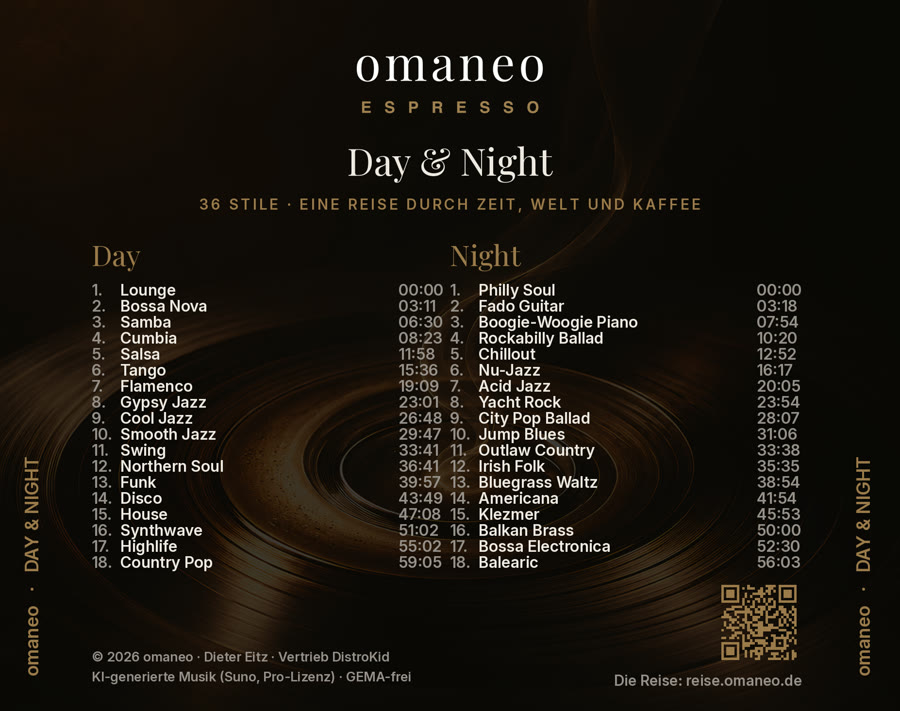
Where a classification reflects the sound of the era rather than the origin of the coffee, that is deliberate — the journey tells of both: of the map and of time.